Over the past few years, the Wilhelm Furtwängler Society China (WFSC) has successively released three society-edition recordings: WFSC-001, WFSC-002-4, and WFSC-005.
These releases serve both as objective historical witnesses to the wartime era and as a reflection of the Society’s ongoing commitment to re-examining historical recordings through contemporary audio technology. The process encompasses the comparison and selection of sources from multiple master tapes, high-precision transcription at 32-bit/192kHz, systematic correction and restoration of pitch, phase, and frequency balance, as well as experimental spatial mixing and remastering of selected tracks. The aim is to maximally restore the dynamic layers and acoustic details of the original recordings while respecting their documentary value, allowing these historical archives to be presented with greater clarity, stability, and fidelity in today’s listening environment.
These three albums respectively compile the most historically significant live recordings and broadcast archives from Furtwängler’s 1940s: from the 1943 Berlin Philharmonic performance of Beethoven’s Fifth Symphony, to the wartime Berlin Ninth Symphony of 1942, and numerous core repertoire works performed by the Berlin and Vienna Philharmonics between 1942 and 1945 – including excerpts from Wagner’s Die Meistersinger von Nürnberg and Tristan und Isolde, the second movement of Bruckner’s Seventh Symphony, Brahms’ Variations on a Theme by Haydn and the fourth movement of his First Symphony – culminating in the 1944 Vienna Philharmonic “Urania Eroica” and the 1942 Richard Strauss Don Juan.
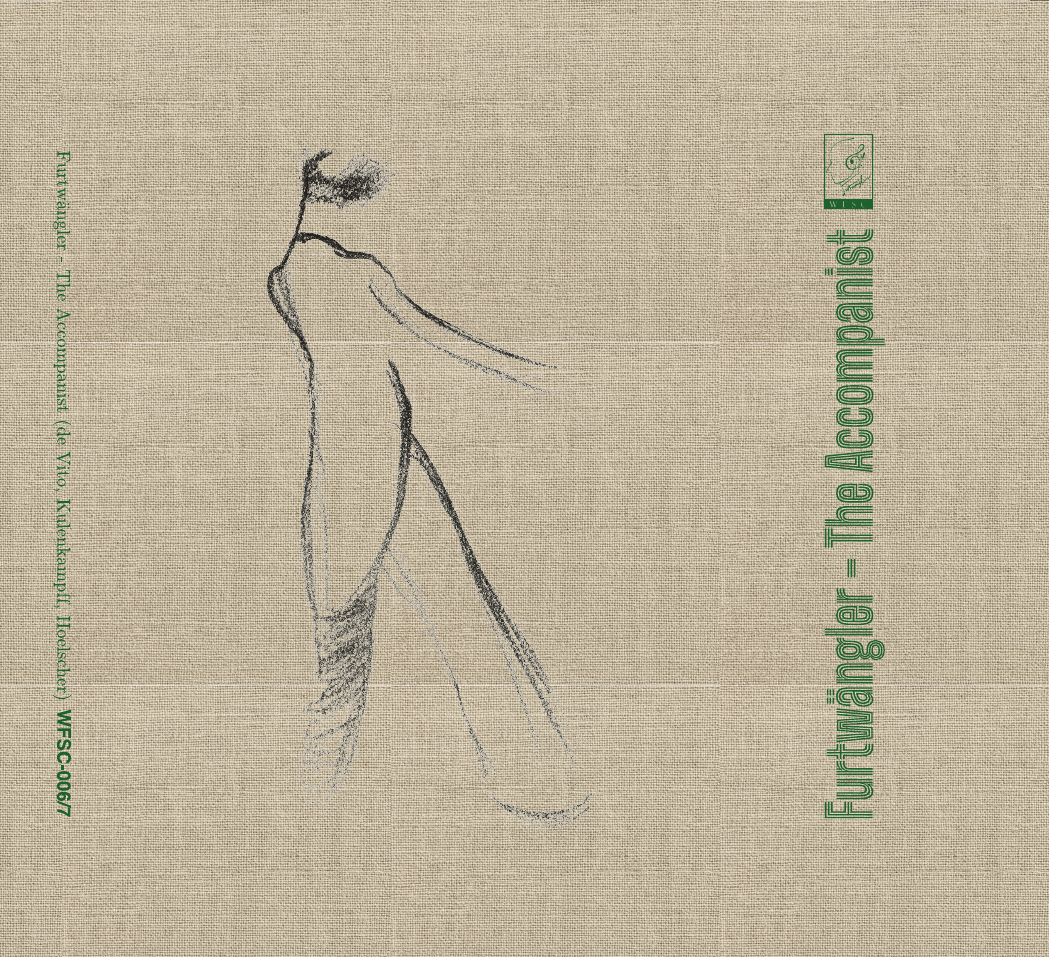
At the outset of 2026, the Wilhelm Furtwängler Society China presents its new society-edition release, WFSC-006/7: Wilhelm Furtwängler – the Accompanist. First unveiled at a Shanghai launch event in December 2024, the album has now been completed after repeated refinements in source comparison, transcription, and mastering.
In contrast to the established image of Furtwängler as an interpreter of symphonies and operas, this double-disc set deliberately shifts the focus to a dimension of his artistry that is more easily overlooked yet equally essential: his role as accompanist and equal partner in concerto performance.
The album features four concerto recordings with Furtwängler as accompanist, spanning the wartime and postwar periods: the 1952 Turin collaborations with Italian violinist Gioconda de Vito in Brahms and Mendelssohn (Orchestra Sinfonica di Torino della RAI, recorded on 7 and 11 March respectively); the 1943 Berlin recording with violinist Georg Kulenkampff in Sibelius (Berlin Philharmonic, recorded 7–8 February); and the 1949 Berlin recording with cellist Ludwig Hoelscher in Karl Höller’s Second Cello Concerto (Berlin Philharmonic, recorded 18 October).
The audio sources used for this release are exclusively the vinyl pressings from when each of these four live recordings first appeared commercially. This approach avoids both the inherent degradation of aged broadcast lacquers and master tapes, and the human intervention introduced during later reissues. Depending on the era of the original masters, two separate vinyl playback systems – each incorporating seven-figure, top-tier equipment – were employed for playback (see the booklet essay for full details). The goal was to capture with precision the complete information preserved within near-unplayed, mint-condition first pressings.
Compared to the restoration of orchestral recordings, restoring concerto recordings demands considerably greater care and nuance. Achieving the right balance in volume and tonal colour between soloist and orchestra lies at the very heart of this society edition.
In pursuit of that goal, through several times the usual hours of analytical listening and a more precise noise reduction process, the high-frequency harmonic variations arising from bow angle, bow speed, right-hand pressure, shifting positions, and string choice have been rendered with greater presence and distinction. The listener is invited to experience the breathing and phrasing of the three soloists in intimate dialogue with the orchestras under Furtwängler’s direction.
Every release from the Wilhelm Furtwängler Society China strives for continuous renewal and advancement, both in the choice of repertoire and in the quality of audio production. The aim is to allow music lovers to revisit these historical sounds with minimal distraction – free from the noise of version hype and the paralysis of too many choices, and without the frustration of hunting down the obscure old CDs mentioned earlier. Instead, listeners can simply and genuinely own a “definitive edition” they will return to for years to come.
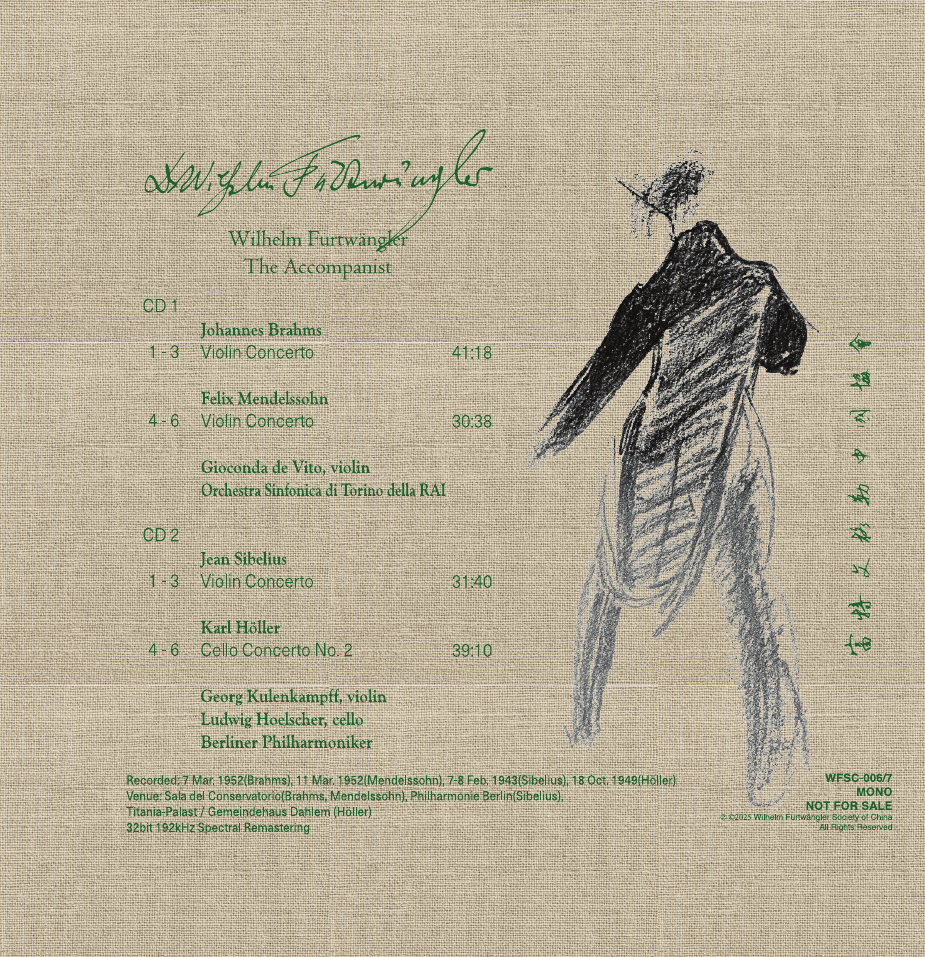
For this release, the packaging has been specifically upgraded. To minimise the risk of box cracking and other damage during shipping, a thick-case, fold-out multi-disc deluxe format has been adopted – the same type used by premium labels such as Esoteric and Tower SACD. All production and packaging work has been carried out in Tokyo, Japan. The accompanying booklet is likewise the most expansive the Society has produced to date, setting a new standard in both the depth of its content and the quality of its design and layout.
Due to a significant rise in production and materials costs in Japan, and taking into account the overall production specifications, packaging structure, and total cost, the WFSC-006/7 double-CD set is priced at ¥168 RMB. Orders placed after the release goes live will be dispatched around 5 March.
Finally, the Wilhelm Furtwängler Society China extends its warmest wishes to all music lovers for a joyful and prosperous Chinese New Year.